You Ordered Pizza, Not a Plan: Part 2
Strategic plans don’t fail in the planning room. They fail at checkout, when a dozen reasonable asks get crunched into one order. Part 2 covers the two pieces of diligence that separate plans that hold from plans that hope.
Stand for nothing, fall for anything. It applies to politics, sports strategy, personal style in the face of relentless IG/TikTok ads, pizza orders, and certainly product strategy. Fail to plant a flag, set limits, and know your own identity, and bad things happen. Your team gets baited into traps a JV coach would see coming. You’re eating a box of cheesy bread next to a closet packed full of unreasonably rigid drop-shoulder boxy tees, “butt-lifting” honeycomb leggings (so I’ve been told), and enough Mediterranean vacation starter packs to sustain a decade of perpetual holiday. (I’ll save the political application for a day I’m desperate for engagement in the comments.)
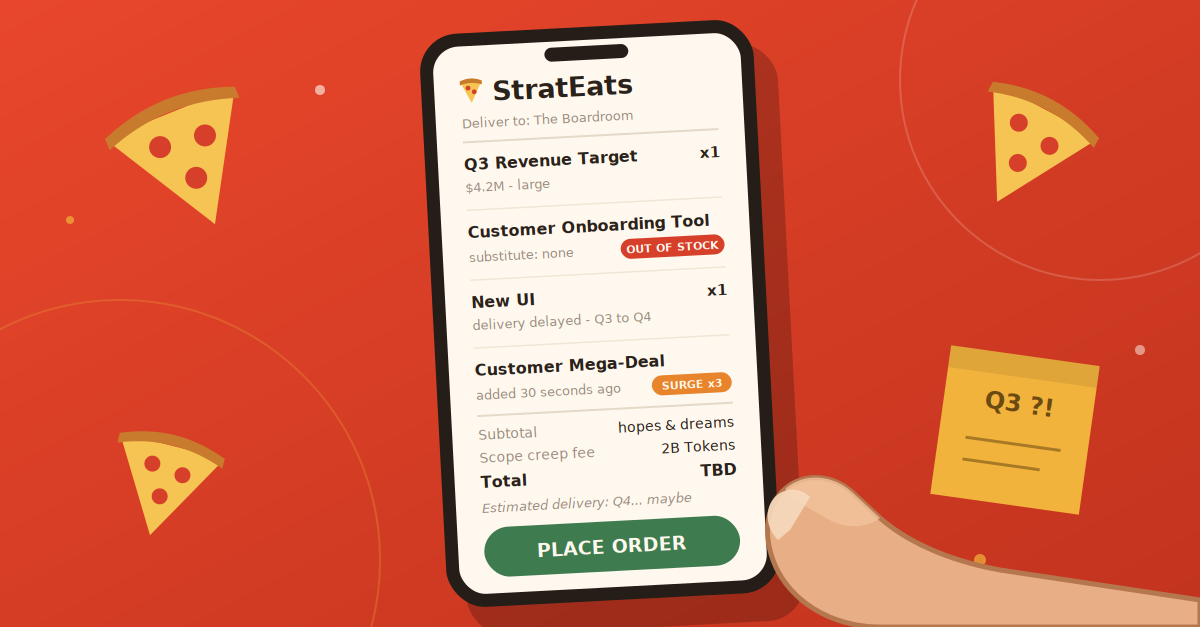
In Part 1 of this post, we likened a strategic planning event to a crowded group chat of friends trying to lock in a pizza order. Even in ideal conditions, conceptualizing a strategy and fitting it to multiple departments + product backlogs is an attempt at solving a complex system of equations, usually without any math or tools to do it. If you’re a stakeholder in Sales, Marketing, or Customer Success, here’s the part that should alarm you. The drift doesn’t happen fully in the group chat. It happens when someone sits down with the Uber Eats app open and has to crunch a dozen opinions into one order. Final calls get made. Shortcuts get taken at checkout.
In Part 2, I want to get into what the real work actually looks like. Not a framework. Not a workshop agenda. Two pieces of diligence that separate plans that hold from plans that hope.
You guessed it. It starts with standing for something. Yes, this is about setting goals, finding a North Star, doing OKRs. Pick your poison when it comes to goal frameworks. But it runs deeper than that. It’s about being honest with yourself and your organization. What are the risks, truly? What’s the current state of your culture, and can it withstand another transition? What obligations have you made to your board? To customers? What are your budgets and capacities across teams, globally? How are you managing AI token spend? And more importantly, how would you distribute those dollars and tokens across your themes, your streams, however you slice the parts of your company that deliver unique value?
If you run multiple products, the questions multiply. Is the portfolio unified? Are you competing on cost or on differentiation? Are you targeting focused or broad markets? Do different products require entirely different strategies?
Baselining your business, having honest conversations with your teams and leadership about where you actually are, is the starting point. But getting those answers just gets you to the starting line. A snapshot isn't an operating model.
Because here’s the biggest issue I see, the one most companies fall victim to (including ones I’ve been part of): the massive gap between that pristine baseline and the messy reality of your actual execution.
If you’re a product company, especially one building software, you have backlogs full of features, epics, initiatives, whatever your planning units are. If those units aren’t translated into how they impact everything you just baselined, you’re running on gut feel. You’re back to hope as a strategy.
Let’s look at that example from Part 1 and expand on it.
Objective: Deliver a world-class onboarding experience that scales as we grow.
Customer Success likely has a set of cascading objectives and plans around this. Maybe it involves developing internal tools. Maybe it means hiring a couple of people, reorienting teams around account types, and building a better training program.
I love this example because internal tools are non-revenue-generating, which makes them notoriously easy to defend in closed, safe settings like a strat plan. When it’s just you and your team, everything is kumbaya and everyone’s looking to get everyone a win.
But internal tools mean product development work. What happens when a directly revenue-generating work stream gets delayed? Or, even more interesting (and a topic for another post), what happens when your biggest strategic customer shows up with a massive deal that would instantly make the quarter but requires a pile of unplanned work? The internal tools get punted. Not necessarily because it’s correct, but because it’s usually the path of least resistance.
And it’s not just the go-to-market teams feeling the pain of these “agile” pivots. Unchecked drift quietly torches engineering morale with constant context-switching and completely obscures the true cost of your development cycles.
My position is that work gets punted like this because teams failed to do not just the initial baselining, but the full scope of quantitatively connecting individual backlog items to their strategy units like goals, commitments, constraints, risks, dependencies, budgets, and streams.
That internal tool in Q1 might not pay off in Q1. It might unlock a massive opportunity in Q2 and Q3, not just hitting the original objective, but also another. None of that gets realized if the tool never sees the light of day in the first place.
If you’re in Sales, in Marketing, and certainly in Customer Success, this is often why your items don’t make the roadmap. Nobody did the diligence of relating each work item to your strategy items, at what proportions, at what ratios. Can you model the impact of NOT doing something? The second-order effects an internal tool has on team throughput, on a goal, on the revenue that goal ultimately maps to?
The general answer is no. And it's not because teams are lazy. Every planning cycle I've sat through points at the same blocker. Connective tissue. The diligence I'm describing is hard, and it has never had a home. The baseline lives in a slide deck. The backlog lives in a ticketing system. The mapping between them lives in your product manager's head, and it starts decaying the moment everyone leaves the room. Keeping that tissue alive takes real product discipline, sound product operations, transparency about the backlog, and a full understanding of where your organization sits in the marketplace. It's no wonder the default is gut feel. Gut feel is the only tool that's always installed. One could argue, outside of the most sophisticated and well-staffed orgs, that establishing and maintaining this connective tissue wasn't even realistic before AI. The breadth and persistence this approach demands were out of reach for humans armed with spreadsheets.
And here’s what you get when the tissue actually exists. Optionality. When the mega-deal shows up mid-quarter, you don’t panic-punt the internal tool. You model the trade. You see exactly which Q2 and Q3 deliverables you’re mortgaging and you decide with eyes open. Pivots stop being fire drills and start being decisions. Drift gets harder to rationalize, because for the first time, drift has a visible price.
This is the problem I’ve spent twenty years circling, and the one I’m now building against at Converge Studio.
As for the group chat. You’ll never make twelve friends agree on pizza toppings and styles. But you can know your options that fit budgets, the dietary constraints, common tastes, and pizzeria availability before anyone hits order. You can make the orderer’s shortcuts visible before they’re baked in. I said in Part 1 that I can’t save your movie night, but I might be able to save your strat plan. Turns out it’s the same fix for both. Stand for something before checkout.
Put this to work: Strategic Alignment. Turning an offsite into decision rules, owners and a plan that re-runs.
← All writing