The End of the Roadmap
What happens when your company finishes every good idea that’s core to its mission? We’re about to find out.
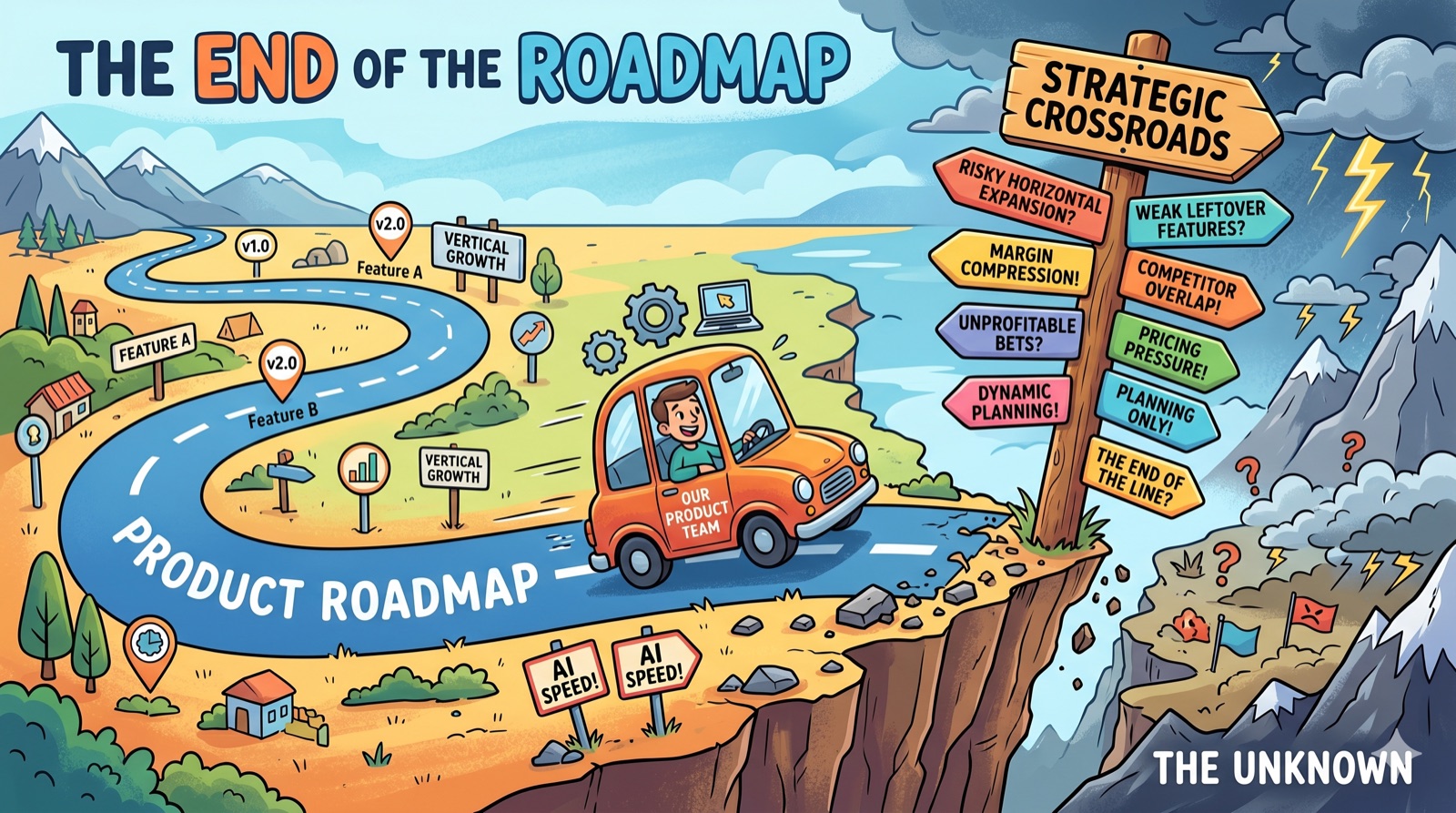
I’m not talking about the idea of roadmaps going out of style. I’m talking about company roadmaps reaching their logical conclusions.
Among a few other things, I build and execute roadmaps for a living. In twenty years, I never once expected to reach the end of one. While feature requests are theoretically infinite, ones that make your company healthy revenue aren’t. Companies grow in one of two directions. Vertically, by going deeper into the thing they already do, more features, more sophistication, more of the core offering. Or horizontally, by expanding outward into adjacent products and markets they didn't serve before. Almost every roadmap is some blend of the two, and for most of corporate history the vertical well was effectively bottomless.
I believe that within the next 24 months, average companies are increasingly going to run out of good ideas inside the friendly vertical confines of their existing mission and strategy. Harnessing AI lets them build at a pace and quality we never anticipated, which means they exhaust their roadmaps faster than they can refill them. A company like Google, with a broad offering to begin with, has far more vertical runway, and a balance sheet big enough to treat horizontal expansion as a portfolio of experiments. It has a graveyard of dead apps and services to show for it, and it barely registers. The average company doesn't get that luxury. It's left with the fringe of the backlog, weak vertical ideas on one side and risky horizontal bets on the other. For a company that size, a failed expansion isn't a write-off, it's an extinction-level event.
A roadmap’s final destination
Many ideas that used to take six months to design, plan, and ship now take a few business days using AI. That speed sounds like pure upside, and for a while it is. The catch is what it does to your backlog. In the old world, those six months bought you time, the market would shift, new needs would surface, and you'd refill the well with fresh big ideas faster than you could empty it. Product managers rarely operated at a deficit. Deficits, like calorie deficits, are great if you're trying to lose weight, but a growing company wants a healthy surplus, and the hardest part of the job was choosing which good option to chase next.
When you can build everything in days instead of quarters, that buffer disappears. You drain the well faster than the market can refill it, and for the first time you find yourself at an idea deficit, staring at a backlog of leftovers. Broadening the offering becomes the logical move once incremental features bolted onto the core stop moving the needle.
What happens in that expansionary world? Say your core product is X. AI lets you build a flawless X incredibly fast. Once you hit diminishing returns and refuse to pad your product with low-value features, you expand into Y. But Y overlaps with someone else's territory. You finish Y and push into Z. Suddenly, your product suite has tripled in a single year. Now picture every software company doing this simultaneously. Businesses that were safely adjacent just one sales cycle ago are suddenly swerving into your lane, and you are in theirs. Unlikely pairings become direct competitors overnight. The bottleneck shifts to the buyer. Your customers can't budget, deploy, or even cognitively absorb the sheer volume of SKUs you are now capable of producing. Everyone is expanding into everyone, outpacing the market’s capacity to consume it.
This was never worth discussing before because it was wildly impractical. You couldn't build that fast. Now you can, and the models are only getting better. So picture how it cascades. Anthropic has already introduced a design offering. Figma, watching its moat get eaten, maybe cooks up a product management offering. Atlassian retaliates with a code editor. GitHub responds by shipping a CRM. Salesforce launches payments. Stripe, having run clean out of adjacent software to colonize, starts selling artisanal ice cream before ever going public. “Churn” and “deficit” take on entirely new meanings.
Exaggerating for effect, of course. But every step in that chain except the last is locally rational. No single company is being reckless. The insanity only shows up in aggregate, which is exactly why no one stops.
An arms race nobody can quit
So no one stops, and that's exactly why this matters if you're the one driving strategy. The expansion is a land grab, but a strange one, because winning it still drags you toward a brutal endgame. When everyone broadens at once, customers can't keep up. Their budgets and their attention don't necessarily grow just because your catalog did, and horizontal sprawl is far harder for a buyer to absorb than one more feature in a tool they already run. Meanwhile every market you enter has more competitors in it than it did a year ago, all arriving at the same time. More supply chasing the same buyers pushes prices down. The companies left standing aren't the ones with the most SKUs. They're the ones nimble enough to survive the margin compression that all this expansion guarantees.
It's an arms race, and the trouble with an arms race is that opting out doesn't stop it. It just means you're the one who gets hurt without changing the outcome. So the only move is to be early. Earlier to expand, earlier to go lean, earlier to see the price pressure coming and adjust before it arrives, maybe by walking away from per-seat SaaS pricing toward outcome-based models that hold up in a world where features are cheap and differentiation is thin. The slow adopters don't save anyone by being slow. They just lose too.
If the well of core ideas runs dry and the only move left is rapid, multi-directional expansion, the bottleneck stops being can we build it and becomes can we decide what to build, fast enough, without losing the plot. The scarce resource isn't engineering capacity. It's the ability to continuously reconcile your strategy against your execution as the ground shifts underneath you, and re-rank what matters before the window closes.
Few of the average-sized companies I've interacted with have that foundation. Most still run a mediocre annual planning cycle only, half-detached from the actual product backlog (I’ve written about this before), and then watch reality diverge from the plan within three weeks. That cadence and approach survived when the well refilled on its own. It does not survive when you're deciding, in real time, which three adjacent markets to enter while four competitors march into yours. You need an operating system where strategy and execution stay connected, where the roadmap is a living reconciliation instead of an artifact you dust off at the next offsite. The companies quietly building that right now are the ones who'll look like they came out of nowhere. They didn't. They just stopped treating planning as a chore and started treating it as the only thing that decides who survives the new era. The roadmap doesn't end because you ran out of things to build. It ends because building stopped being the hard part.
Put this to work: Product & Portfolio Operations. A portfolio rollup leaders can actually decide from.
← All writing