Software Ate the Culture
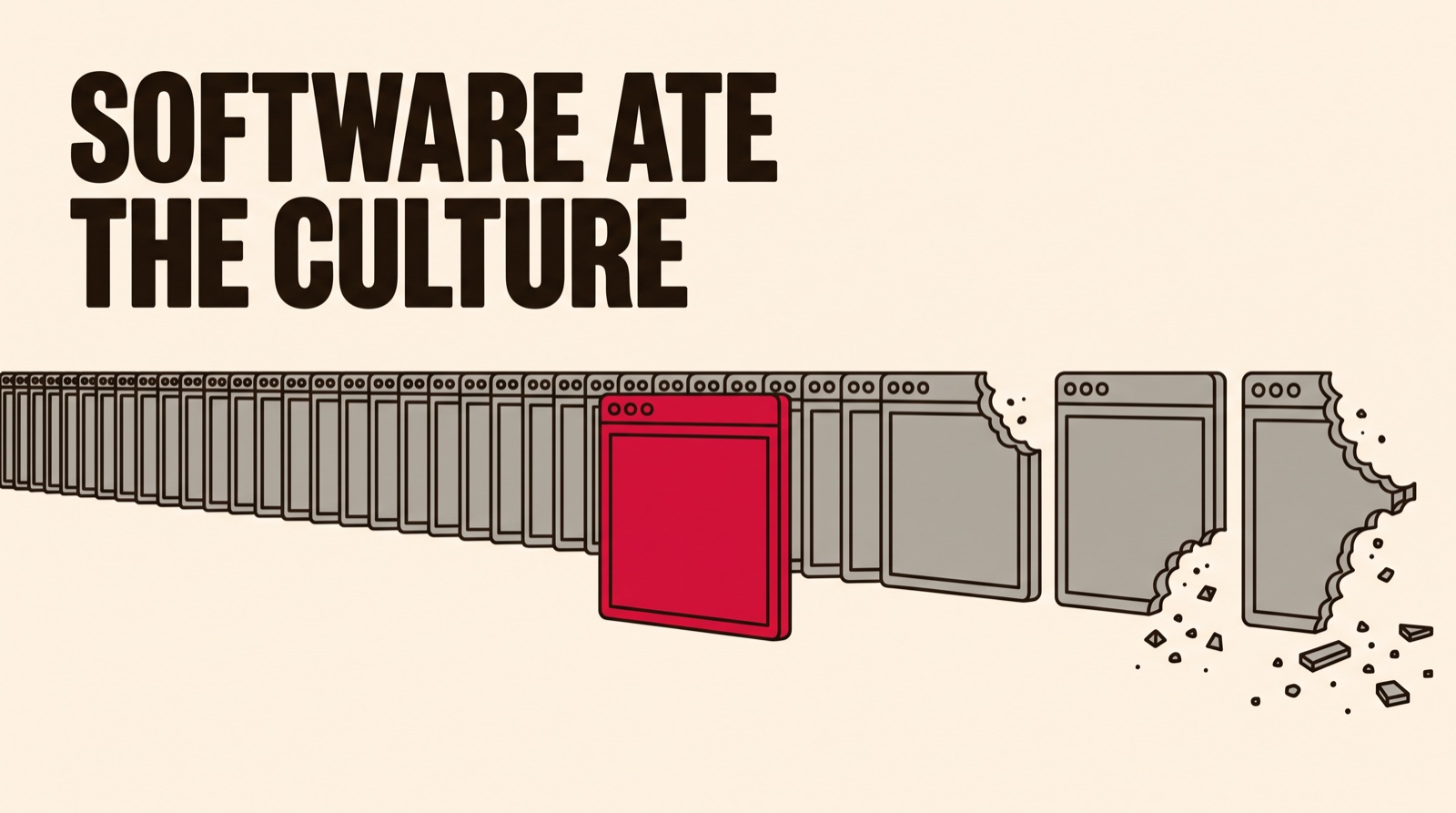
We took our stale, milquetoast culture and built a machine exceptionally good at reproducing it. Twenty years of software culture on a quad box, a conformist quadrant I think we’re stuck in, and an open invitation to tell me I’m wrong.
Nirvana and the non-conformity movement defined the culture during my high school years. In college and grad school, my classmates in the math program were blissfully uninterested in validation outside the classroom. My first proper tech role turned out to be more of the same, only with better stories. It was gated by an entrance exam that weighted the ability to imbibe Johnnie Walker scotch equally and concurrently with the logic exam itself. The exam administrator / CEO, an amazing Greek who took a chance on me, mashed golf balls down the hallway all day, shouting “Nice country, America” any time someone paid us for services. After an acquisition, my second CEO, a German physics PhD, roundhouse kicked me in the face (lovingly) at a party in a dank basement bar in Heidelberg, Germany, while lecturing me on how I wasted my time studying math and not physics. The first engineer I looked up to had a giant tattoo of our solar system across his entire belly. The first consultant I shadowed rolled up to work every morning racked on two Starbucks ventis, carrying a little black book, which held not personal contacts but handwritten SQL tricks and, deeper in, already ancient COBOL, protected like Nic Cage protected the Declaration of Independence. The software we were building was complex and powerful. It also had hidden video game easter eggs in it if you knew where to click. I knew this was a space I’d never leave.
The start of that first role was nearly 20 years ago and I’m just as committed to the space today as I was then. But there has been a serious cultural vibe shift. For the worse. Mavericks have become bro-ligarchs, who have pulled up the ladders behind them. Edginess and originality got swapped out for hollow values like “ownership”, “be bold”, and “impact”. They sound like an upgrade until you realize they come with approval processes and preinstalled guardrails. That’s just obedience with extra steps. The average PE firm is busy hollowing out our seasoned companies, swapping souls for EBITDA bridges. The average VC has turned early stage companies into an echo chamber, backing the same Stanford dropout on the same thesis…until the thesis changes, of course. Every Web3 fund turned into an AI fund before we could blink. When the money is that fickle, it’s hard not to expect the culture downstream of it to get fickle too. It’s rough out there. Am I being dramatic? Sure, but I’d challenge anyone to take the opposite side of that without using a “value returned to shareholders” argument. Great, people have made serious money. But at what cost?
I’ve got deeper concerns about the space and its trajectory, separate from what AI may do. Allow me to explain in terms of a classic tech tool, the quad box. The x-axis is culture, running from Conformist to Rebel. The y-axis is the software itself, running from Boring to Distinguished. By “boring,” I don’t mean technically unsophisticated or unimportant. I mean software that expresses little personality and looks or behaves much like everything around it. I’m also grading the median output of each era, not its greatest exceptions. Every era produced breakthroughs. What changed was what the era made common.
Rebels with Boring Software [2001 – 2008]
This is where I came in. The dot-com crash had just cleared the room, the tourists were gone, and the people left standing were the true believers. The culture was rebellious. The approaches were raw and gritty, and the people were quirky. The probability you were an interesting person if you worked on building software was high.
The culture ran on essays and message boards. Paul Graham was writing the founding documents and YC launched in 2005 on the bet that a couple of weird hackers were worth more than a business plan. Joel on Software taught a generation of us how to think about building product before “Product” was a career.
I won’t pretend it was all romantic, however. The same culture that produced belly tattoos and basement roundhouse kicks was also a boys’ club with a real Mad Men tilt to it.
Much of the era’s most consequential work disappeared into plumbing like nginx, Git, Hadoop, and AWS. When products did express rebellion, it often came through restraint rather than flashiness. Craigslist still looks like it did in 2001 (that’s the joke, and also the point). Google’s empty homepage was an anti-portal statement in a world of cluttered Yahoos. Gmail launched on April Fools’ Day 2004 with a gigabyte of storage nobody believed was real. Firefox 1.0 was open rebellion against IE6. Windows XP’s great achievement was largely invisible, bringing mainstream Windows users onto the NT architecture. This era laid excellent foundations, but the prevailing product aesthetic was cold, impersonal, and constrained by the interfaces of the time.
Rebels with Distinguished Software [2009 – 2019]
Fast forward a few years. Maybe you call this the golden age for working in software. The financial crisis had just pushed a wave of talent out of Wall Street and into tech, YC was blowing up, and the tech hubs were expanding their recruiting far beyond the usual suspects. As more and more money came into the space, more people did. But the people were mostly cool. They were fun. They didn’t speak in jargon. We certainly didn’t solve inclusion, but we grew more conscious of it. Even the satire was affectionate. HBO’s Silicon Valley roasted us for six seasons, and we quoted it back lovingly, because the show did have some appreciation for the thing it was mocking.
The most boring, homogenizing force in the space was the push for Agile, and even that wasn’t enough to bring down the vibes.
The software itself, primitive by today’s standards, had personality. Twitter went down so often that its error page became a beloved mascot (RIP, Fail Whale). Slack shipped with playful loading messages. Early Instagram and Snapchat felt like they were made by actual humans for actual humans. Stripe put more care into its developer docs than most companies put into their actual products. The ratio of cypherpunk ideals to grift in Bitcoin and Ethereum was nothing like it is today. Design craft got major attention and its own infrastructure with Dribbble in 2009, Sketch in 2010, the iOS 7 flat design reset in 2013, Material Design a year later. React, Node.js, Zoom, Notion, and Figma emerged. Marc Andreessen told us software was eating the world, which felt like a tailwind for going bigger and being brave.
Conformists with Distinguished Software [2020 – 2022]
Perhaps it was a result of the COVID lockdowns, the proliferation of podcasts, and information becoming so readily accessible that everyone started copying everyone else. The seeds were planted earlier, to be fair. LeetCode and the FAANG playbook were already memed by the mid-2010s. But lockdown flattened the whole industry into a single podcast-and-Twitter feed, and that’s when the copying went from seldom-used desperation tactic to identity. The thought leaders started leading with their thoughts, and everyone afraid to make a mistake fell in line behind them.
Think of the All-In podcast with Chamath Palihapitiya, David Sacks, Jason Calacanis, and David Friedberg. In the beginning, it was a unique experience for people looking for an edge, talking about deals and tech. After a while, it became repetitive. They were so invested in standing out, in being the non-conformists, that the act itself became the conformity. As a former resident of Williamsburg, Brooklyn, I’ve seen this movie. Hipsters out-hipstered each other until “Hipster” became the default. In my opinion, All-In’s reach and relentless push to signal “elite” played a big part in neutering the culture. It didn’t help that the rest of Silicon Valley, also busy preaching first-principles thinking, did it exclusively styled in awful, gray wool Allbirds sneakers. The average SMB had no business carrying themselves like they’re the Valley’s next unicorn darling, but instead of staying true to their roots, they let peer pressure talk them into cosplaying as one. Inauthenticity was what really shined in most cases. There is no greater example than the army of LinkedIn posters desperate to promote their companies and brands via “what [insert family tragedy] taught me about B2B SaaS Sales” posts.
Somewhere in here, the average EQ in the space started to dip. I’m not going to relitigate the rise and fall of woke and DEI here. Wherever you stand on it, the shift came. Somewhere in the backlash, “I’m just being honest” became a personality. The All-In guys and their imitators made it aspirational to be dismissive and to treat empathy as some sort of tell that you didn’t have what it takes to win. What got marketed as a return to keeping it real morphed into a green light to be an asshole. And a massive chunk of the industry, scared as always of being on the wrong side of the prevailing vibe, hit the gas.
The money conformed too. This was the ZIRP copycat wave, where fifteen-minute grocery delivery somehow supported a half dozen identical venture-backed players. Gorillas, Getir, Jokr, Gopuff. Nobody was asking whether the business worked. They were asking who else was funding one.
On the software side, Clubhouse is the parable of the era. A novel product showed up and within months nearly every incumbent had cloned it: Twitter Spaces, Spotify Greenroom, LinkedIn Audio Events, Facebook Live Audio Rooms. Then many of them shut down, scaled back, or stopped talking about it almost as quickly. A conformity speedrun in just a couple of years!
Culture shifts rot the software on a bit of a lag, however. Supabase and Linear were a new take on familiar categories. GitHub Copilot changed how developers worked. DALL·E, Midjourney, and finally ChatGPT introduced entirely new capabilities. Figma and Notion kept redefining their categories. Zoom rose to the occasion, keeping us connected during lockdowns and making work video conferencing less miserable.
Conformists with Boring Software [2023 – now]
This era starts in 2023 not because the technology changed at midnight, but because that’s when the new capabilities began diffusing through the entire industry. AI itself is not boring. These models will almost surely go down as some of the most consequential technologies of our lifetimes. Again, what I’m calling boring is the median product being built with them. The capability layer is exploding while the application layer is converging. The same tools that let two people build what once required a funded team of thirty also let ten thousand people ship the same defaults.
I believe this new era is headed down an ugly path if we’re not careful. The thought-leader echo chamber has continued to drain the spirit of tech communities. Big tech, now inclusive of OpenAI and Anthropic, has reached full escape velocity. Many SMBs live in fear that their entire business model becomes the next simple “feature” released by the machine. Andreessen’s “eating” quote might need to be amended to “Big Tech is eating the world” soon.
If you want the era in a single image, it’s the row of tech CEOs seated at the January 2025 inauguration. The same industry that once scandalized Wall Street by wearing hoodies and t-shirts to IPO roadshows showed up in matching suits, in assigned seats, to kiss the ring on live television.
EQ is at an all-time low. I used to think finance bros held that title, but it has definitely shifted. I feel like I can say this as a card-carrying tech bro, but tech bros are the new worst people. And to me, the straw breaking the camel’s back is software design itself. At the time of writing this, we’ve finally started to exit the era of the purple gradient. It hurts me to say this because I love purple and I love gradients, but the copycat nature of every application that was built the past couple of years is just astounding. Now the slop cannons are core infrastructure. v0, Bolt, and Lovable are all genuinely impressive, but at the same time are complicit in producing more and more of the same cookie-cutter templated sites and apps. shadcn/ui is slick for sure, but as a stock implementation for every single vibe coder’s app? It loses its luster. The fact that the ONLY way we can think of to represent AI in an icon form is via the “sparkle” is a perfect microcosm for where we’re at.
I would call this irony if it wasn’t science. These models learn from the patterns we feed them, and every default in the pipeline, the training data, the prompts, the component libraries, pulls their output toward the most familiar answer. Sameness and conformity are the paths of least resistance, and we’ve fully productized those paths. We took our stale, milquetoast culture and built a machine exceptionally good at reproducing it.
The Worst Quad Box
Now don’t @ me. I understand designing for conversion. I understand that when a pattern works, it gets repeated and it gets copied because it’s the thing that works and human behavior is generally consistent across similar types of applications, across similar user bases and similar geographies. But what I want to call out is the willingness to be different, to buck trends, to push back against current default mentality. That’s what’s missing.
Every podcast you listen to, everything you read, comes down to conforming to the ideals of Big Tech, VC, and PE. Those models exist because they make money. I get that. But my question is this: When does it stop being the optimal play? When everything is this blatantly uniform, when there’s only one obvious path and everyone is on it, what’s the trade? As AI coding tools push the same approaches to the same problems, and the models get retrained on that output, where does it all lead?
Back to the quad box. Conformist culture, boring software. Bottom left. The worst box we’ve ever been in, and the first time in my career we’ve occupied it.
I for one am not afraid to push back. I want to work with people who defy the defaults. The ones who hear “re-underwrite my thesis”, “let me steelman this”, and “founder mode” and throw up in their mouths a little. The ones who roll their eyes when someone asks about a company’s “AI strategy” as if it’s a checkbox, without knowing or caring whether they mean the product, the internal operations, or something else entirely, because the phrase sounds important and that’s the whole point of saying it.
Here’s what gives me hope. It has never been easier to start a company. The same tools flooding the feed with slop have collapsed the cost of building, and a couple of people with taste can now ship what used to require a well-funded team. Being lean today is more about choice, less about compromise. And if you don’t need the money early, you can design your foundation and let your culture emerge independent of the gatekeepers. No fund thesis to flatter, no pattern to match, and no pitch deck that looks like everyone else’s.
The inertia keeping everyone in the bottom left is real. It’s a crowded quadrant, but it’s safe. I’m not writing this from the sidelines, though. I strayed off the comfortable path to build something on my own, and every design decision I make is a small bet that different still beats default. But if enough of us make that bet at the same time, the bottom left empties out on its own. Come as you are.
Put this to work: AI-Assisted Product Development. Making coding assistants reliable, reviewable and honestly priced.
← All writing